
Assessing the Allocation Value of Newly Launched Thematic Semi ETFs (Equipment/Materials/HBM)
Semiconductor themed ETFs used to be simple. You bought a broad fund like SMH or SOXX, got exposure to the sector’s biggest names, and let the cycle do the work. That world is changing fast. A wave of newly launched tactical semi ETFs now targets very specific slices of the value chain: equipment, materials, and high‑bandwidth memory (HBM). Instead of “chips,” the story becomes “tools,” “chemistry,” and “memory bottlenecks.” The question for allocators is not whether these themes are interesting—they clearly are. The real question is whether these tactical ETFs add meaningful allocation value on top of traditional broad semi exposure.

Answering that question means looking beyond recent performance headlines. It means asking what each subtheme actually represents, how concentrated the new funds are, how they behave in different market regimes, and whether they diversify or simply amplify what you already own. Equipment, materials, and HBM all sit in the semiconductor stack, but they occupy very different positions. Tactical ETFs built around them can either become powerful tools or narrow trading instruments, depending on how they are used.
Why Tactical Semi ETFs Are Emerging Now
The timing of these launches is not accidental. The AI wave has exposed several specific bottlenecks inside semiconductors. One is memory bandwidth—HBM has become critical for feeding GPU and accelerator workloads. Another is specialized equipment—EUV lithography, etch, deposition, and test tools are now central to capacity expansion. A third is materials—advanced chemistry and substrates underpin yield and node scaling.
Issuers are responding by launching ETFs that focus on these specific bottlenecks and enablers rather than just the final chips. The pitch is simple: if you believe AI and advanced semis will keep growing, own the pieces of the stack that are structurally scarce and strategically important. In many cases, that leads straight to HBM memory names, equipment companies, and high‑value materials suppliers.
From an allocation perspective, the appeal is clear. Instead of owning the whole sector, you can lean into the parts with the sharpest leverage to the next leg of demand.
HBM-Focused ETFs: Pure Bottleneck Plays
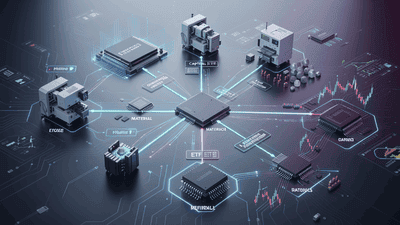
HBM‑themed ETFs concentrate on memory companies and related equipment or materials tied directly to high‑bandwidth memory demand. These funds are essentially bottleneck plays. Their core premise is that AI workloads will continue to require more memory bandwidth than current architectures can easily provide, forcing substantial investment into HBM capacity and technology.
Allocation value here comes from specificity. Rather than owning memory only as a piece of a broader semi ETF, you own it as the focal point. That can be attractive if you believe the memory cycle is entering a super‑cycle phase and want a clean vehicle for that view. HBM ETFs tend to include the major DRAM/HBM producers and select suppliers in the equipment and materials chain that stand to benefit from memory‑focused capex.
The trade-off is concentration and volatility. These funds can be highly sensitive to memory pricing, capacity announcements, and AI‑related demand surprises. They may outperform dramatically when HBM is the market’s favorite bottleneck and underperform when attention shifts elsewhere. As an allocation, they fit best as a tactical satellite, not a core holding.
Equipment-Themed ETFs: The Capex Lever
Equipment‑focused semi ETFs target the companies that sell the tools used to build chips and memory—lithography systems, deposition, etch, inspection, packaging, and test equipment. Their allocation value comes from their position at the front line of semiconductor capital expenditure. When fabs expand capacity, adopt new nodes, or ramp packaging, equipment orders move first.
In many ways, equipment ETFs are cyclical but structurally advantaged. They tend to lead during upturns because capex decisions precede production and revenue. They also tend to reflect how serious the industry is about long‑term expansion. For allocators, that makes them a useful barometer of the health and direction of the semiconductor cycle.
Allocation value here is about timing and leverage. An equipment ETF can tilt a portfolio toward the investment side of semiconductors. That may be especially attractive when AI or HBM demand forces the industry into a capex catch‑up phase. The risk is that equipment names can be more volatile and more sensitive to capex pauses or policy shocks. As with HBM, equipment ETFs work best as a distinct sleeve for investors who actively manage sector timing.
Materials-Themed ETFs: The Quiet Backbone

Materials‑focused ETFs concentrate on companies supplying specialty chemicals, gases, substrates, photoresists, and related inputs to semiconductor manufacturing. These are quieter names compared with headline chip or equipment leaders, but they play a crucial role in yield, performance, and process complexity. Allocation value lies in their combination of strategic importance and sometimes less‑crowded positioning.
Materials exposure can provide diversification inside a semiconductor allocation. Materials firms may be less directly exposed to single end‑products and more tied to steady supply relationships and process innovation. When node transitions and packaging advances matter, materials suppliers can enjoy persistent demand even when unit cycles wobble.
A materials ETF can therefore act as a stabilizing layer within semi exposure. It may not capture every spike in AI‑driven sentiment, but it can participate in the broader upgrade cycle while potentially exhibiting different volatility and drawdown patterns than pure chip or equipment baskets. For allocators, that can be useful when building a more nuanced semiconductor profile.
Core vs. Tactical: Where These ETFs Sit
The most important allocation question is where to place these new tactical semi ETFs in a portfolio. They are not obvious core replacements for broad semiconductor funds. HBM, equipment, and materials all represent focused slices of the stack. Their strengths are in specificity, not in broad coverage.
As a result, they fit most naturally as tactical satellites around a core semi ETF holding. A broad fund can provide diversified exposure to the sector’s main drivers. Tactical HBM, equipment, and materials ETFs can then be overlaid in smaller weights to express stronger views about where the next wave of returns is likely to come from.
That framework—broad core plus tactical satellites—protects against overconcentration in any single bottleneck while still letting the portfolio lean toward high‑conviction themes.
Assessing Incremental Allocation Value

To decide whether a newly launched tactical semi ETF adds allocation value, ask three questions:
- Does it provide exposure I cannot get easily in my existing core funds?
- Does it behave differently enough (in cycles and volatility) to broaden my sector profile?
- Does it align with a specific thesis I am willing to manage actively?
For HBM, the answer may be yes if your core ETF is underweight memory or treats it as one of many segments. A pure memory/HBM fund can sharpen your exposure to that theme. For equipment, the answer is yes if you want more direct leverage to capex and infrastructure investment beyond what broad funds offer. For materials, the answer is yes if you want to tilt toward the quieter but critical backbone of production.
Allocation value diminishes if the tactical ETF simply replicates what your core funds already hold, or if it adds complexity without a clear, actionable thesis.
Risk Profile and Correlation Considerations
Each of these tactical semi ETFs carries a distinct risk profile. HBM funds may be more correlated with memory cycles and AI hardware narratives. Equipment funds may be more correlated with semiconductor capex cycles and broad industry investment sentiment. Materials funds may be more tied to process transitions and sometimes to domestic substitution stories in specific regions.
In practice, that means their correlations with your core semi exposure will vary by regime. In strong global risk‑on phases, all of them may move broadly with the sector. In more nuanced environments, HBM may diverge based on memory pricing, equipment on capex signals, and materials on supply chain and policy themes. The more those correlations deviate from your core fund, the more diversification benefit a tactical allocation can offer.
That is why it is useful to treat these ETFs as distinct risk buckets rather than as interchangeable “semiconductor” labels.
Liquidity, Concentration, and Cost
Newly launched tactical ETFs also need to be judged on practical grounds. Liquidity affects how easily you can enter and exit positions. Concentration affects how much individual company risk you are taking. Fees affect how much of the theme’s upside you can actually keep.
HBM funds that heavily weight just a few memory leaders may have high single‑name risk. Equipment or materials ETFs focused on a small group of suppliers may do the same. Rising assets under management and healthy trading volumes can mitigate some concerns, but the structural design remains important. Broadify where necessary, especially if you intend to hold tactically rather than trade intraday.
Cost matters too. Tactical themes often come with higher expense ratios than plain vanilla sector funds. Allocation value must exceed that cost. If the ETF simply adds a narrow tilt without delivering distinct behavior, the fee may not be justified.
When Tactical Allocation Makes Sense
Tactical allocation to these new semi ETFs makes most sense in three scenarios:
- You see a clear, time‑bound opportunity in a specific bottleneck, such as an HBM supercycle or an upcoming wave of equipment orders.
- You want to hedge or balance a core semi exposure that is heavily tilted toward design names by adding suppliers and infrastructure players.
- You are building a more granular semiconductor profile and are comfortable monitoring multiple subthemes actively.
Outside those scenarios, a broad semi fund may remain the simplest and most effective exposure. Tactical ETFs are tools, not mandatory upgrades. They pay off most when you have a reason to use them.
Conclusion
New tactical semiconductor ETFs focused on equipment, materials, and HBM are a natural evolution of the sector’s ETF landscape. They reflect the industry’s own shift toward recognizing specific bottlenecks and value‑creation points rather than treating semis as a monolithic trade. For allocators, they can add meaningful value—but only if used thoughtfully.
As satellites around a core semi allocation, HBM, equipment, and materials ETFs can sharpen exposure, refine risk, and align portfolios more closely with high‑conviction themes in the AI era. As standalone replacements for broad funds, they are too narrow and too volatile. The real edge comes from combining breadth with precision. Tactical semi ETFs deliver the precision. A good allocation framework makes sure that precision enhances, rather than destabilizes, the bigger picture.
You May Like

Narrowing Spread Between NAND Spot and Contract Prices in 2026 – A Signal
By 2026, one of the most watched metrics in the NAND flash market has started to shift in a subtle but meaningful way: the spread between spot prices and long‑term contract prices is narrowing. For casual observers, this may look like just another incremental change in a notoriously volatile industry. For memory makers, module houses, device OEMs, and data center buyers, however, a tightening gap between spot and contract prices is a signal—a reflection of evolving supply–demand balance, risk perceptions, and strategic behavior on both sides of the market.

Price Divergence Trading Strategies Between NAND Flash and DRAM ETFs
NAND flash and DRAM sit at the core of AI storage and computing power. Both are memory, but they are not the same business. DRAM is main memory—fast, volatile, and central to high‑bandwidth workloads like AI training and inference. NAND is non‑volatile storage—slower than DRAM, but crucial to persistent data and large‑scale object storage. The cycles that drive their pricing and margins overlap, yet they often diverge. That divergence is where trading strategies between NAND and DRAM ETFs become interesting.

China’s HBM Localization Progress: The Catch-Up Pace of CXMT and XMC
China’s drive to localize advanced memory technologies has accelerated over the past several years. High-Bandwidth Memory (HBM) sits near the center of that strategy because it is integral to AI accelerators, high-performance computing (HPC) and other strategic compute platforms. Two domestic players—ChangXin Memory Technologies (CXMT) and XMC (Xianghui Memory, commonly referred to as XMC)—have become focal points in assessing how quickly China can close the gap with international incumbents on HBM die, stacking, and packaging.

Thermal Simulation Challenges and Solutions in 3DIC AI Chip Design
As AI workloads push chips to deliver ever higher compute density, designers are increasingly turning to three‑dimensional integration (3DIC) to stack dies vertically and pack more functionality into limited footprints. While 3DIC architectures unlock significant performance and bandwidth advantages, they also introduce complex thermal behaviors that are far harder to predict and manage than in traditional 2D layouts.
An Attempt at Compiling a Memory+Compute Fusion Thematic Index – A Dual-Track Framework
Most AI investors talk about “compute” as if it were the whole story: GPUs, accelerators, chips, cores. But every one of those cores needs somewhere to read from and write to. Memory and storage define how wide the data highway really is. In practice, AI performance is a fusion of compute and memory, not a solo act. So why do so many indices and ETFs separate them into different silos—one for semiconductors, one for memory, one for data centers—when the actual workloads keep blending them?

Surging Demand for Laser Drilling and Plasma Dicing Equipment in Advanced Packaging
Advanced packaging has become one of the semiconductor industry’s most important growth engines, and it is now pulling a surprising set of process tools into the spotlight. Among the most in-demand are laser drilling and plasma dicing equipment. These machines sit close to the heart of heterogeneous integration, fan-out packaging, wafer thinning, TSV formation, glass substrate processing, and other advanced flows where precision, yield, and throughput matter enormously. As packaging moves from a back-end afterthought to a strategic platform, the equipment used to shape, open, and separate materials has become just as important as the dies themselves.
D2D Interface Bandwidth and Latency Comparison in Chiplet Architectures
Chiplet architecture has turned the package into a real performance battleground. Once multiple dies are placed side by side or stacked within the same advanced package, the quality of the die-to-die, or D2D, interface becomes one of the most important determinants of system behavior. Bandwidth is no longer a nice-to-have metric, and latency is no longer a small implementation detail. Together, they shape whether a chiplet system feels nearly monolithic or frustratingly fragmented.

Stock Selection Logic and Alpha Validation of ESG-Themed Semi ETFs
Semiconductor themed ETFs are no longer just about growth and cycles. A growing subset now layers environmental, social, and governance (ESG) criteria on top of traditional sector exposure. These ESG semi ETFs promise two things at once: access to one of the market’s most powerful secular themes, and alignment with sustainability and governance standards. The pitch is appealing, but it raises two hard questions. First, how exactly are these stocks being selected? Second, does the ESG overlay help, hurt, or leave alpha unchanged?