
Market Sentiment Revealed by Changes in Semi ETF PCF Baskets
If you spend any time in the semiconductor space, you quickly realize that prices do not move only on earnings calls and product launches. They also move on flows, on mechanics, on the quiet, daily processes that keep exchange-traded funds running. One of the most important of those processes is the construction of the Portfolio Composition File, or PCF – the basket that authorized participants use to create and redeem ETF shares. When we talk about semi-themed ETFs, the evolution of those PCF baskets can be a surprisingly rich source of information about what the market is really thinking.

On the surface, a PCF looks like a simple list: these are the stocks, these are the quantities, here is the cash component. In reality, it is a daily, distilled expression of how the ETF sponsor sees the semiconductor sector at that moment, how corporate actions and index rules are interacting, and how they expect demand to show up. For traders and investors who are willing to read between the lines, changes in semi ETF PCF baskets can reveal shifts in risk appetite, sector rotation, and even the subtle tilt of sentiment toward specific corners of the chip ecosystem.
PCF Baskets 101 in Plain Language
Before we dig into sentiment, it helps to strip away the jargon. PCF stands for Portfolio Composition File. Every ETF publishes such a file each trading day, typically before the market opens, and sends it to authorized participants and market makers. The PCF spells out exactly what an authorized participant needs to deliver – in stocks and cash – to receive a “creation unit” of ETF shares, or what they will receive back when they redeem units. It is the recipe for building and dismantling ETF supply.
In a semiconductor-themed ETF, that recipe might include a mix of chip designers, foundries, memory producers, equipment makers and related technology names. Sometimes the basket is fully “in-kind”: all securities. Sometimes it is hybrid: a set of securities plus a cash component that cleans up tracking differences or accounts for dividends and corporate actions. Importantly, the PCF is not frozen. It is recalculated every day based on the prior close’s net asset value, expected corporate actions, and the index rules the ETF follows. That daily recalculation is where sentiment starts to seep into the story.
From Mechanics to Meaning
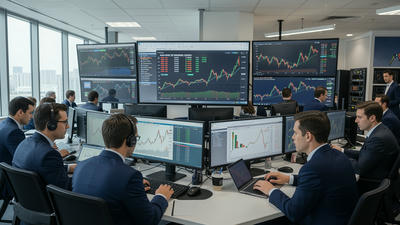
Formally, the goal of the PCF is straightforward: help maintain tight alignment between the ETF price and its underlying net asset value. By telling authorized participants what basket to trade in exchange for ETF units, the PCF allows them to step in whenever the ETF trades at a premium or discount, buying or selling the underlying stocks and tightening the gap. That’s the mechanical side.
But markets are rarely just mechanical. The way an ETF sponsor designs and updates its PCF basket reflects a blend of rules and judgment. Even for index ETFs, corporate actions, liquidity considerations and local regulations can cause the PCF basket to diverge slightly from the fund’s exact holdings. For active semi ETFs, that judgment is even more pronounced. Over time, patterns in how certain stocks appear, disappear, or change weight in the PCF can tell you something about how the ETF is positioning for the next leg of the cycle, and, by extension, how professional money is feeling about the sector.
Semi PCF Changes as a Sentiment Gauge
Think of changes in semi ETF PCF baskets as a mood ring, but for capital. When demand for a semiconductor ETF is strong, authorized participants deliver the PCF basket to the issuer in exchange for new ETF shares – the creation process. When selling pressure rises, they do the reverse, redeeming ETF shares and receiving the underlying basket back. The point is: every creation and redemption transmits the structure of the PCF into the market as real buy and sell orders in the underlying stocks.
Now layer on the fact that PCF contents can shift in response to index rebalances, corporate actions, liquidity filters, and sometimes tactical choices by the manager. You start to see how a pattern of changes across several days or weeks can embody sentiment:
- More weight to high-beta chip designers can reflect growing optimism about AI-driven upside and risk-taking behavior.
- A tilt toward equipment makers and foundries can hint at a focus on capacity cycles and capital investment themes.
- Higher cash components or more use of substitute securities can point to caution, liquidity management, or uncertainty about near-term price discovery.
None of these signals are perfect, but taken together, they turn the PCF from a dry spreadsheet into a living indicator of the market’s mood.
Creation Baskets and Risk Appetite

When investors rush into a semiconductor ETF, authorized participants need to assemble PCF baskets and deliver them to the issuer. The composition of those creation baskets can highlight what kind of risk investors are willing to embrace at that time. In an optimistic phase, PCF baskets for semi ETFs may be heavy with volatile, growth-oriented names – companies at the bleeding edge of AI accelerators, high-bandwidth memory, or frontier lithography. Creation activity in that context reinforces those names’ rallies as APs buy them in the market to build baskets.
In a more cautious phase, PCF baskets may lean towards relatively stable, cash-generative chip makers, analog specialists, or diversified tech conglomerates whose semiconductor exposure is only part of the story. The authorized participants, following the PCF, end up bidding more for these “safer” names when they create units. At the same time, if the PCF has trimmed more speculative holdings, creation flows into those names slow down or even reverse. The net result: PCF changes show, in concrete terms, where the market’s comfort zone lies along the risk spectrum.
Redemption Baskets and Flight to Safety
On the flip side, when semi ETFs fall out of favor, redemption becomes the order of the day. Authorized participants accumulate ETF shares on the secondary market and return them to the issuer, receiving the PCF redemption basket in exchange. That basket is, in principle, the same as the creation basket; in practice, its effect can highlight where selling pressure is most intense.
If a semiconductor ETF’s PCF basket is dominated by high-beta stocks during a selloff, then redemptions translate into heavy selling in those names as APs offload the basket into the market. You see this in sharp corrections where the most popular growth stories suddenly gap down as ETF flows hit the tape. Over time, ETF sponsors may respond by altering the PCF composition – slightly increasing exposure to more robust names, or adjusting cash levels – to smooth operations. Such adjustments, captured in the next day’s PCF, can reveal a shift toward a “flight to safety” stance in the way the fund interacts with the market.
Daily Tweaks and Micro-Signals

Not all PCF changes are large-scale rebalances. Many are subtle: a small increase in the weight of an equipment maker, a slight reduction in a second-tier memory producer, the replacement of one stock with a close peer due to liquidity constraints or corporate actions. These micro-adjustments can still carry sentiment signals, especially when they cluster around certain segments of the semi universe.
For example, a sequence of PCF updates that gradually reduce exposure to cyclical, commodity-like memory names and increase exposure to more structurally growing analog or power management firms can tell you something about how the ETF sponsor perceives the next stage of the cycle. Similarly, adding newly listed semiconductor companies to the PCF basket soon after their IPO may hint at enthusiasm for new business models or technologies. If such changes coincide with upticks in creation activity, you have a pretty clear indication that the market is not only intrigued but willing to commit capital.
PCF, Liquidity, and Market Microstructure
Another dimension where sentiment shows up is in how PCF baskets handle liquidity. Semi ETFs operate in markets where some names are extremely liquid, while others are more thinly traded. ETF sponsors and market makers must balance index purity with practical execution. When sentiment is strong and flows are robust, they may be more willing to include smaller, less liquid names in PCF baskets, trusting that demand and market depth will support those trades.
Conversely, during periods of stress or uncertainty, PCF baskets may give more weight to liquid megacaps and rely more heavily on cash components or proxies to avoid squeezing fragile stocks. This is not mere caution; it is a reflection of the market’s collective anxiety about price impact and slippage. Observers who track PCF adjustments can detect this shift – when the basket suddenly looks “heavier” with household names and lighter with speculative plays, you are probably looking at a market that has moved into defense mode.
Reading Sector Rotation Through the Basket
Semiconductor is not a monolith. Within semi-themed ETFs, the PCF basket often spans multiple sub-industries: logic vs. memory, analog vs. digital, fabs vs. fabless, equipment vs. devices, and more. When sentiment rotates between these buckets, the changes typically show up first in PCF updates, then in price action.
Suppose the market starts to worry that AI spending is peaking in the near term, while industrial and automotive demand for power semis remains strong. In that scenario, an ETF sponsor might adjust its PCF basket to slightly reduce weights in the most richly valued AI-driven logic names and increase exposure to more cycle-resilient analog and power management companies. The authorized participants, following the PCF, shift their buying and selling accordingly during creations and redemptions. Over days and weeks, those flows bring about a rotation in performance – one that began as a subtle change in a file few investors ever read directly.
Corporate Actions and the Sentiment Layer
Corporate actions add another layer of complexity. Dividends, stock splits, rights offerings, mergers, and spin-offs all lead to changes in PCF baskets. For instance, a cash dividend that goes ex on a particular day will be baked into the PCF’s cash component for the following trading day, ensuring the creation and redemption baskets properly reflect the fund’s economics. Mergers might remove one company and increase exposure to another; spin-offs might introduce a new stock to the basket.
While some of these changes are purely mechanical, they can still intersect with sentiment. If a major chip company announces a spin-off that investors view positively – say, carving out a fast-growing unit – the ETF’s decision to include the new entity in the PCF basket early and at meaningful size can reinforce that constructive view. Conversely, when corporate events are messy or controversial, you may see PCF baskets reflect caution: limited early exposure, or a reliance on cash until the situation clarifies. Again, the PCF is doing its operational job, but the pattern of decisions tells you how the ETF sponsor and, indirectly, a slice of the institutional market feels about the situation.
Active Semi ETFs: PCF as a Positioning Map
For actively managed semiconductor ETFs, the PCF basket becomes even more interesting. Because these funds do not simply replicate an index, their PCF reflects their discretionary positioning. When they adjust the basket, they are deliberately reweighting companies, themes, and risk factors. The daily PCF then serves as a transparent snapshot of their evolving view.
A manager who grows more bullish on a particular subsector – say, leading-edge packaging or AI networking chips – will express that view by increasing positions in the fund, which then appear with higher quantities in the PCF basket. As creations and redemptions occur, those views propagate into the broader market through the APs’ trading activity. By observing PCF evolution across time, a close watcher can infer where active managers see opportunity, where they are cutting risk, and how quickly they are responding to macro or policy developments affecting semis.
Limitations and False Signals
Of course, PCF baskets are not clairvoyant. Not every change in a semi ETF’s PCF is a meaningful sentiment signal. Some adjustments are purely mechanical: dealing with corporate actions, complying with listing rules, aligning the basket to tracking requirements, or handling idiosyncrasies in specific markets. Reading too much into a single day’s change can easily lead you astray.
There is also the challenge of information accessibility. While PCFs are formally published, not all investors follow them closely. Much of the detailed interpretation happens on trading desks and among specialized analysts. Retail investors may only see the downstream price moves, without knowing that a seemingly random spike or drop in a semi name was triggered by a busy redemption day and a particular basket composition. As a result, PCF-based sentiment analysis is mainly a tool for those willing to dig deeper, cross-reference changes with flows, and separate noise from signal.
Turning PCF Insight into Strategy
For those who do pay attention, PCF changes can be woven into a broader strategy toolkit. A macro-oriented investor might track how semi ETF PCF baskets evolve across cycles, using shifts in sub-industry emphasis, liquidity profiles, and cash usage to gauge when the market is transitioning from optimism to caution or vice versa. A more tactical trader could monitor daily PCF updates to anticipate which names are likely to see concentrated creation or redemption flows, preparing to trade around that short-term pressure.
Even long-term investors can benefit. Understanding that certain short-term moves in their holdings are flow-driven – the direct result of how an ETF’s PCF translated into creation or redemption trades – can prevent overreaction. Instead of panicking at a sudden dip caused by a heavy redemption basket, they might view it as an opportunity to add at better prices, knowing that the fundamental story has not changed. In that sense, PCF awareness helps bridge the gap between market microstructure and fundamental investing.
PCF Baskets as a Window into the Semi Psyche
At the end of the day, PCF baskets are technical documents. They exist to ensure ETFs function smoothly, respect regulations, and maintain tight tracking to their underlying portfolios. Yet in the semiconductor world – a sector defined by rapid change, cycles, and intense investor focus – those technical documents inadvertently become a window into the collective psyche of the market.
When semi ETF PCF baskets tilt toward aggressive growth, favor smaller innovators, and embrace higher beta exposure, you are probably in a phase of confidence and risk appetite. When they retreat to cash, megacaps, and defensive names, the mood has shifted to worry and capital preservation. Between those extremes, daily tweaks quietly chronicle rotations in themes and sub-industries. Reading those signals requires patience and nuance, but for those who make the effort, PCF changes can be an invaluable complement to earnings, valuations, and macro data.
Conclusion
Changes in semi ETF PCF baskets may look like back-office details, but they are anything but irrelevant. Through creation and redemption, through the ebb and flow of cash and securities, these baskets translate sentiment into trades, shaping how semiconductor stocks move, correlate, and ultimately price in the stories investors tell themselves about the future of technology.
As semi ETFs continue to grow in size and influence, their PCFs will remain a daily heartbeat of the sector’s mood—steady on some days, racing on others, occasionally hinting at a change in rhythm before the headlines catch up. For investors who want to understand not just what the market is doing, but how it feels, paying attention to those changes can turn an obscure file into a powerful lens on sentiment in one of the most dynamic corners of global markets.
You May Like

Narrowing Spread Between NAND Spot and Contract Prices in 2026 – A Signal
By 2026, one of the most watched metrics in the NAND flash market has started to shift in a subtle but meaningful way: the spread between spot prices and long‑term contract prices is narrowing. For casual observers, this may look like just another incremental change in a notoriously volatile industry. For memory makers, module houses, device OEMs, and data center buyers, however, a tightening gap between spot and contract prices is a signal—a reflection of evolving supply–demand balance, risk perceptions, and strategic behavior on both sides of the market.

Price Divergence Trading Strategies Between NAND Flash and DRAM ETFs
NAND flash and DRAM sit at the core of AI storage and computing power. Both are memory, but they are not the same business. DRAM is main memory—fast, volatile, and central to high‑bandwidth workloads like AI training and inference. NAND is non‑volatile storage—slower than DRAM, but crucial to persistent data and large‑scale object storage. The cycles that drive their pricing and margins overlap, yet they often diverge. That divergence is where trading strategies between NAND and DRAM ETFs become interesting.

China’s HBM Localization Progress: The Catch-Up Pace of CXMT and XMC
China’s drive to localize advanced memory technologies has accelerated over the past several years. High-Bandwidth Memory (HBM) sits near the center of that strategy because it is integral to AI accelerators, high-performance computing (HPC) and other strategic compute platforms. Two domestic players—ChangXin Memory Technologies (CXMT) and XMC (Xianghui Memory, commonly referred to as XMC)—have become focal points in assessing how quickly China can close the gap with international incumbents on HBM die, stacking, and packaging.

Thermal Simulation Challenges and Solutions in 3DIC AI Chip Design
As AI workloads push chips to deliver ever higher compute density, designers are increasingly turning to three‑dimensional integration (3DIC) to stack dies vertically and pack more functionality into limited footprints. While 3DIC architectures unlock significant performance and bandwidth advantages, they also introduce complex thermal behaviors that are far harder to predict and manage than in traditional 2D layouts.
An Attempt at Compiling a Memory+Compute Fusion Thematic Index – A Dual-Track Framework
Most AI investors talk about “compute” as if it were the whole story: GPUs, accelerators, chips, cores. But every one of those cores needs somewhere to read from and write to. Memory and storage define how wide the data highway really is. In practice, AI performance is a fusion of compute and memory, not a solo act. So why do so many indices and ETFs separate them into different silos—one for semiconductors, one for memory, one for data centers—when the actual workloads keep blending them?

Surging Demand for Laser Drilling and Plasma Dicing Equipment in Advanced Packaging
Advanced packaging has become one of the semiconductor industry’s most important growth engines, and it is now pulling a surprising set of process tools into the spotlight. Among the most in-demand are laser drilling and plasma dicing equipment. These machines sit close to the heart of heterogeneous integration, fan-out packaging, wafer thinning, TSV formation, glass substrate processing, and other advanced flows where precision, yield, and throughput matter enormously. As packaging moves from a back-end afterthought to a strategic platform, the equipment used to shape, open, and separate materials has become just as important as the dies themselves.
D2D Interface Bandwidth and Latency Comparison in Chiplet Architectures
Chiplet architecture has turned the package into a real performance battleground. Once multiple dies are placed side by side or stacked within the same advanced package, the quality of the die-to-die, or D2D, interface becomes one of the most important determinants of system behavior. Bandwidth is no longer a nice-to-have metric, and latency is no longer a small implementation detail. Together, they shape whether a chiplet system feels nearly monolithic or frustratingly fragmented.

Stock Selection Logic and Alpha Validation of ESG-Themed Semi ETFs
Semiconductor themed ETFs are no longer just about growth and cycles. A growing subset now layers environmental, social, and governance (ESG) criteria on top of traditional sector exposure. These ESG semi ETFs promise two things at once: access to one of the market’s most powerful secular themes, and alignment with sustainability and governance standards. The pitch is appealing, but it raises two hard questions. First, how exactly are these stocks being selected? Second, does the ESG overlay help, hurt, or leave alpha unchanged?